They each have their own quirky habits and gestures that I used to think were just personality traits.
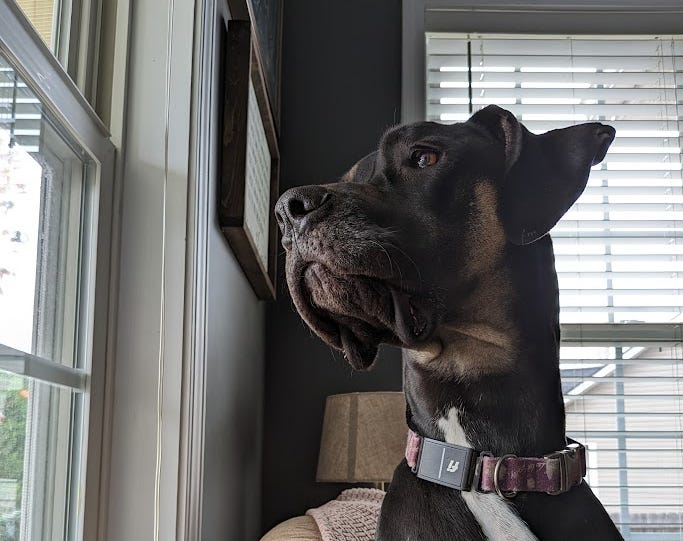
Rae will randomly bump me with her nose: sometimes on my belly, sometimes my side or leg. If I hold out my hand, she’ll press her nose into my palm, almost like she’s saying, “Hey, I’m here.”
Moose, on the other hand, has this thing where he’ll paw at me. It is almost always with his right paw. He does it first thing in the morning on the side of the bed or later in the day when I’m sitting at my desk, just enough to graze my leg. If I’m working on the computer, he’ll rest his big head next to my elbow, as if he’s trying to interrupt my thoughts with something more important, his presence. Almost always accompanied by a heavy sigh.
I’m not always receptive to these interruptions. I’m not out to be rude, but sometimes I’m trying to focus and it is hard to disengage. They will try for a few moments, leave me alone if I insist on ignoring them, and come back in maybe 6-8 minutes to try again. Moose is the most patient-persistent, but Rae can’t do it more than twice before she goes outside or takes it out on something like a cheese stick.
For the longest time, I chalked it all up to routine affection. Recently when learning about how dogs are trained to interact with people with anxiety and autism, it began making sense. When dogs are trained to recognize anxiety or panic attacks, these are exactly the kinds of behaviors they’re taught: physical nudges, grounding touches, gentle interruptions.
This stuff is meant to distract from the anxiety, produce calming behaviors, and basically reduce the likelihood of panic from occurring.
Service dogs are taught to provide routine by reminding or politely asking for walks (specific daily activities), because routine keeps the environment predictive (comforting). Or engaging with those cues, I talked about, that serve to provide comfort and help me (us) regulate emotional or sensory overload.
And the crazy thing is, both of them do it naturally. No one taught them this.
I started noticing the pattern. They only act this way when I’m stressed, anxious, or starting to spiral. When I’m deep in it, they get more insistent like they’re saying, “Come on, it’s time to move.” This is the hardest time to get me to engage, because my mind immediately goes, “I have no idea what they may want and I’m freaking out too much to try and guess!”
But they’re right. When they get me up, they start to move me, literally. They will move me from the computer to the living room, and instantly they want to play. “Oh, that’s what this is about!” Is usually my thought.
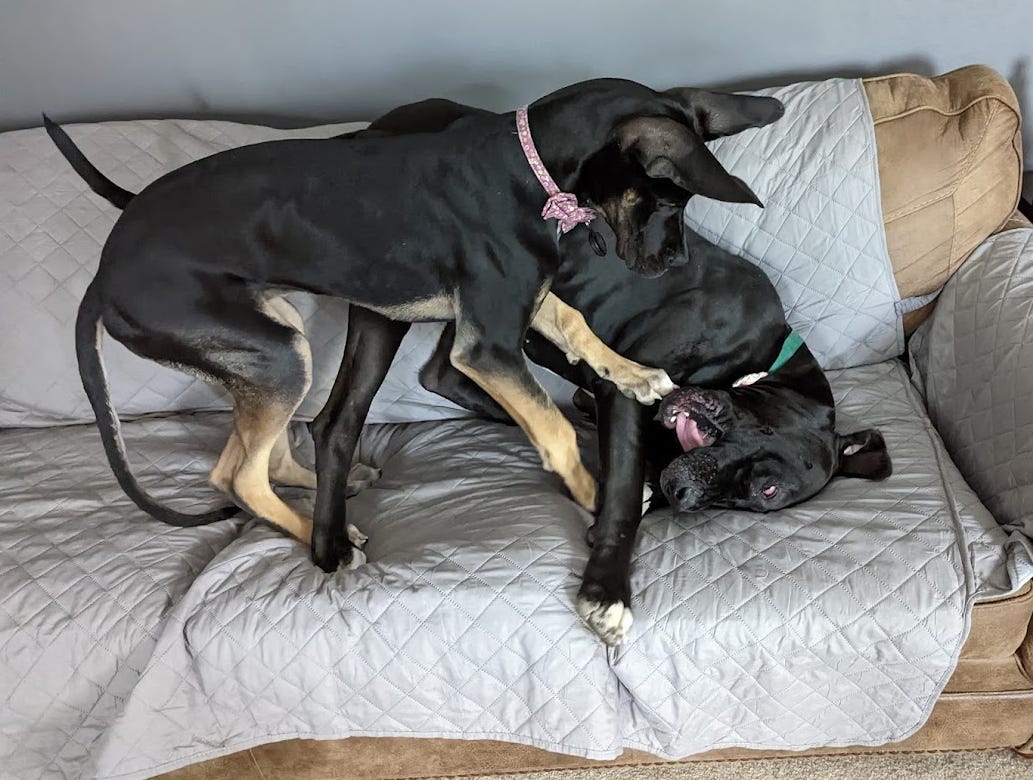
Now, keep in mind, play with them is no small thing. They’re big dogs. Moose likes to jump up and push against me. Think full-body hits, like he’s trying to wrestle the stress out of me. He’s not into toys or tug-of-war; he just wants to shove his weight around, and he is heavy.
Rae’s energy is different. More like freaking wild and fast! She wants to grab a toy and shake the life out of it, pull hard, run faster. Where Moose is strength, Rae is speed. And together I get exhausted quickly, even if I barely spend time doing it. They are almost always irritated when I walk away or disengage. I can only recall a few times they decided to quit before me, it is rare.
This happens a lot by the way, and more even recently.
I seldom came close to appreciating what they were doing…
Last Friday night I was talking to my friend Ry about how the body releases stored stress and tension. He mentioned cardio or pushing heavy and unmovable objects can also let stress out. I’m not easy to get angry, if ever, but the feeling of wanting to have physical resistance is applicable for lots of people, Shibari might do something similar if I understand the motivations correctly.
He asked if I did anything like those and I said, “Well, I walk the dogs,” but Mandi jumped in with, “walking isn’t cardio!” And she’s right. It’s not a sustained effort to increase your heartbeat; walking is just movement without reaching the point of stress release. So the answer was “No, I’m not doing things that would release stress in that way. I’ll have to find some ways to do that.”
Fast forward to Sunday when the dogs got me into their trap, I realized THIS is what Moose and Ray are doing for me. They’re not just trying to trick me into playing, they’re helping me discharge my physical (invisible) stress. Moose with the pressure and heavy wrestling, Rae with the aerobic routine.
Two different biological mechanisms, capable of releasing different depths of stress. They instinctively do what trainers spend months teaching service dogs, but without any training at all.
Because they feel my tension, often sensing it even before I do. I don’t always realize when I’m stressed; it manifests physically long before my mind catches up. But they see it, they feel it, and they act on it.
That realization hurts and warms me. I seldom came close to appreciating what they were doing, or for sure not consciously. I just thought they were being their goofy, loving selves. But really, they’ve been taking care of me all along.
I believe there’s something profoundly beautiful in that. Their quiet, biological harmony of love expressed through a protective instinct. A kind of communication that transcends words in a way that doesn’t need translation.
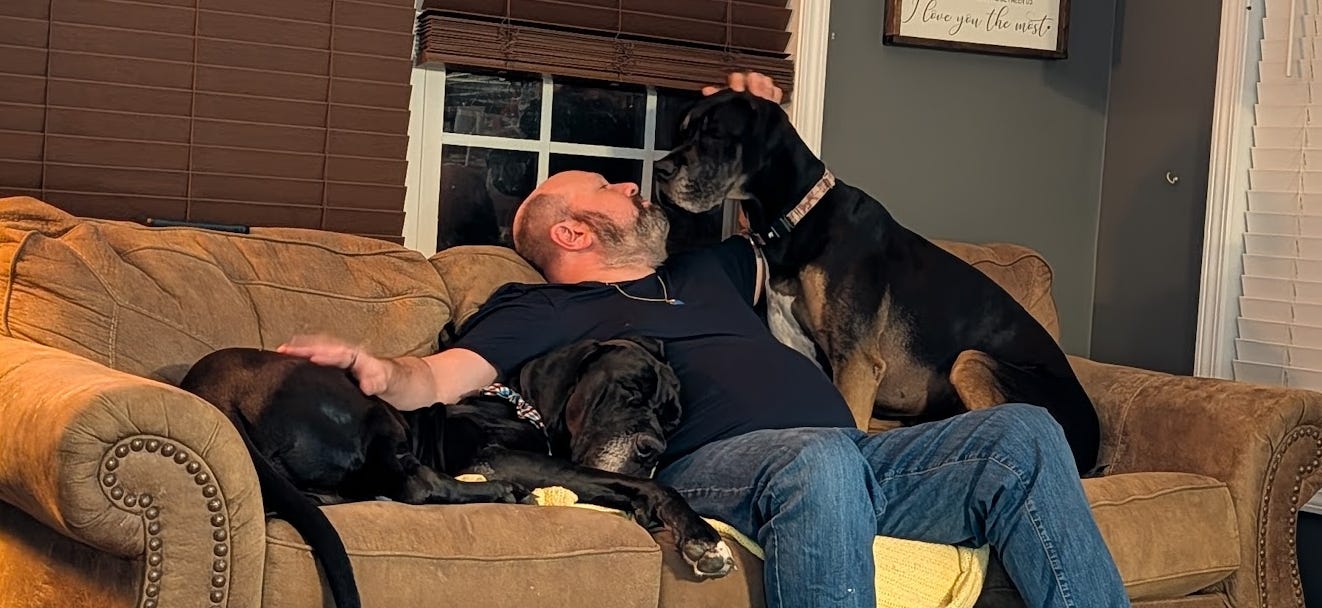
They don’t need to understand what stress is. They just know that their family hurts sometimes, and that they can help. And they do. Every day.
Now I can lean into that help, complimenting their efforts instead of feeling more frustration, because I will know what they are telling me, and what we are going to do.
I don’t know about everyone else’s dogs, but mine… mine are pretty amazing.
-js