
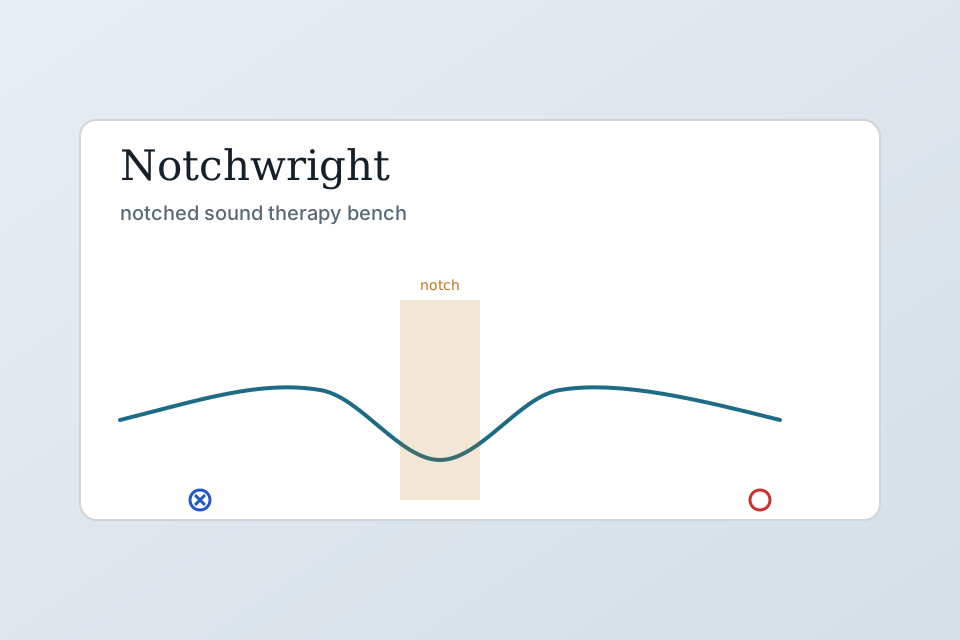
Notched music training (sometimes called tailor-made notched music training, TMNMT) removes a band of frequencies around the tinnitus pitch from music the listener already likes. The idea is lateral inhibition: quieting the over-active tonotopic region by removing its input. Notchwright builds that filter in the browser, schedules real-notch weeks against sham-notch weeks, and logs loudness so you can see whether the difference beats your day-to-day noise.
It is not a medical device and not medical advice. The safety tab is there because some tinnitus needs a clinician first.
The best single trial
Stein et al. (2016) ran a double-blind, placebo-controlled trial of tailor-made notched music in 100 people with chronic tonal tinnitus (50 notched, 50 placebo), two hours a day for three months. Primary outcomes — tinnitus handicap and several visual-analog ratings — showed no treatment effect. At one-month follow-up, rated loudness was lower in the treatment group; distress findings did not hold up the same way. That null on the main outcomes is why Notchwright treats notched listening as something to test on yourself with a control, not as a settled therapy.
Later reviews disagree with each other
Piromchai et al. (2024) meta-analyzed three studies (99 people on notched music, 109 on ordinary music listening). On Tinnitus Handicap Inventory scores, notched music was not clearly better than listening to ordinary music.
A separate review of fourteen trials (PubMed 39992369) reported lower THI and loudness scores for notched music versus conventional music after three months. Different inclusion rules, different protocols — the field has not settled.
Who the signal seems limited to
Where benefit shows up at all, it tends to be people with steady, tonal tinnitus below about 8 kHz and mild hearing loss. Noise-like or multi-tone tinnitus was often excluded from the trials. Notchwright’s match step flags those patterns and says so. Listening itself — attention, routine, expectancy — may explain part of any change. That is another reason the default plan blinds real notch against a sham notch an octave away.
Notch width
The plan tab offers half an octave (Stein 2016) or one octave (Okamoto et al. 2010). Pick one and keep it for the whole schedule so blocks stay comparable.
What Notchwright does with this
It does not claim the notch works. It gives you the same kind of within-person contrast a careful trial would want: baseline, alternating blocks, daily loudness, optional THI/TFI, and an unblind step when you are ready. Your bookmark stores that log so a later visit can pick it up. Export JSON if you want a copy that does not depend on the server.